


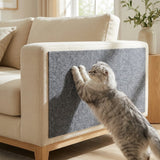


Apartment cats do not need a mansion. They need a floor plan that respects feline priorities: height, hiding, hunting reps, and resources that are not all stacked in one contested corner. The failure mode is familiar. A new tree arrives on Saturday. By Wednesday it is a laundry rack, and the cat is staring at a closed bedroom door again.
This how-to turns the five feline environmental-needs pillars into a small-space build you can finish in a weekend. Educational only. Multi-cat tension, elimination outside the box, or sudden behavior change still warrants professional help.
What you'll get
- A "used after day one" test for every enrichment idea
- Vertical, foraging, and play setups that fit studio and one-bedroom footprints
- Resource separation when square footage is tight
- Soft product links only where they fill a clear job
The day-one test
Before you buy or build anything, ask three questions:
- Does it let the cat finish a behavior? (Catch a toy, eat a puzzle meal, exit a hide two ways.)
- Is it in the room the cat already uses? (Same rule as scratching posts: location beats perfection.)
- Will it still be novel or useful on day ten? (Rotation and daily short hunts beat static clutter.)
If the answer is no, it will become ignored décor.
Indoor safety is not enough (a point feline vets reinforced in a 2025 indoor-cat statement). Emotional and physical needs still need deliberate design. Apartments simply force you to design more carefully.
Idea 1: Steal height you already own
Vertical space is a pillar-level need (safe places; elevated rest). Height works as confidence and escape terrain.
Apartment moves that get used:
- Clear the top of a sturdy bookcase and add a non-slip mat
- Leave one closet shelf accessible with a soft bed
- Install two or three floating shelves as a highway (secure into studs; measure jump distances your cat already clears)
- Place a compact tree beside a window, not in a dead hallway
Day-one failure: A tall tree blocking the only path to the sofa so humans shove it aside. Put height where the view and the social life already are.
Idea 2: Two short hunts, not one guilt marathon
Cats get used to unchanging toys fast. Rotate toys and let every session complete the hunt.
Apartment play kit:
- One wand stored out of sight
- One soft capture toy
- One cardboard box or tunnel segment for ambush
- Optional puzzle feeder for meals
Run five minutes before work and five minutes before bed. End with a catch and a few calories. That pattern beats leaving a battery toy chirping alone all afternoon.
Casa Michi tools that fit this kit: Treat Dispenser Toy, Interactive Cat Tunnel, and Catnip Balls for responders, all in Toys & Playtime.
Idea 3: Turn calories into foraging
Free-choice bowls or one to two huge meals often ignore behavioral feeding needs (per a 2018 veterinary feeding consensus). Puzzle feeders, multiple small meals, and food placed in more than one safe location help cats hunt for dinner.
Small-space foraging:
- Start with an easy rolling puzzle
- Hide a portion of dry food in a muffin tin or paper bag (handles removed) twice a week
- Use elevation for one feeding station only if the cat can jump comfortably
- Keep food away from the litter box even when the bathroom is the only "utility" room. A hallway shelf feeder beats food beside the box
Day-one failure: An advanced puzzle that frustrates the cat into giving up. Difficulty should climb slowly.
Idea 4: Separate resources without a second bedroom
Pillar two asks for multiple, separated key resources: food, water, toileting, scratching, play, rest. In a studio, "separated" might mean opposite corners and vertical splits rather than separate rooms.
Studio pattern that works:
- Litter on the quieter end; food on the opposite end
- Water in a third spot (many cats prefer water away from food)
- Scratcher beside the sofa arm that already gets clawed
- One covered hide (box, carrier, tunnel) plus one elevated perch
Multi-cat apartments need duplicates. Tension between cats is often subtle. One litter box for two cats in a narrow bath is a common stress machine.
Idea 5: Scent and quiet are enrichment too
Pillar five respects smell and other senses. Apartments concentrate cooking odors, cleaning products, and hallway smells. Practical moves:
- Leave some cheek-rub zones unpolished every day
- Avoid blasting strong cleaners near rest areas
- Offer a cardboard scratcher that can carry the cat's own scent
- Keep a carrier out as a bedroom so it is not only a vet trap
A weekend build checklist
Saturday morning (60 minutes)
- Clear one high surface and one hide
- Move litter and food farther apart if they share a wall
- Place a scratch surface beside the furniture hot spot
Saturday evening (15 minutes)
- First complete wand hunt ending in a treat
- Introduce an easy puzzle with a few kibbles
Sunday
- Bin all but two floor toys; start a rotation list on your phone
- Watch where the cat rests. Add a soft layer there, not where you wish they rested
Reassess in seven days. Keep what earned voluntary use. Relocate what earned sniff-and-abandon.
What to skip (for now)
- Giant activity centers that consume the only open floor lane
- Ten toys dumped at once
- Laser-only play with no catch
- Enrichment that requires constant adult babysitting if your schedule cannot support it (choose foraging and stable perches for solo hours)
FAQ
How much space does enrichment need?
Less than you think if you use vertical planes. A secure shelf highway plus a window perch can outperform a bulky unused tree.
What if my landlord bans wall shelves?
Use freestanding trees, cleared furniture tops, and window seats with tension-mounted perches rated for your cat's weight. Safety first.
Can plants count as enrichment?
Some cats enjoy cat grass. Many houseplants are toxic if chewed. Verify plant safety before you create a salad bar.
Where should I start if I can only do one thing?
A daily five-minute hunt that ends with a catch, plus one elevated rest spot in the room the cat already loves. Add foraging next.
Takeaway
Apartment enrichment fails when it is décor. It works when it is placed on existing pathways, supports complete behaviors, and stays fresh through rotation. Lean on the five pillars: safe height, separated resources, predatory play, predictable social time, and scent-aware calm. Small square footage is a design constraint, not a reason your cat should live in a blank box.
Sources
- Ellis SLH, et al. AAFP and ISFM Feline Environmental Needs Guidelines. Journal of Feline Medicine and Surgery, 2013. https://journals.sagepub.com/doi/10.1177/1098612X13477537
- FelineVMA. 2025 indoor cats position statement news release (Aug 28, 2025). https://catvets.com/news/2025-indoor-cats-position-statement/
- Hall SL, Bradshaw JWS, Robinson IH. Object play in adult domestic cats. Applied Animal Behaviour Science, 2001/2002. https://eprints.soton.ac.uk/55585/
- Sadek T, et al. AAFP consensus statement on feline feeding programs, 2018. https://www.avma.org/javma-news/2018-12-15/aafp-releases-consensus-statement-how-feed-cat
- Dantas LMS, et al. Food puzzles for cats. Journal of Feline Medicine and Surgery, 2016. DOI: 10.1177/1098612X16643753
- AAHA. Purrfectly Entertained: indoor enrichment for cats. https://www.aaha.org/resources/purrfectly-entertained-indoor-enrichment-for-cats/
- 2024 AAFP Intercat Tension Guidelines. Journal of Feline Medicine and Surgery, 2024. https://pmc.ncbi.nlm.nih.gov/articles/PMC11292941/