




Keeping a cat indoors reduces many outdoor risks. It does not automatically meet a cat's physical and emotional needs. That is the message of a 2025 indoor-cat position statement from the Feline Veterinary Medical Association (FelineVMA), and it is simple and a little humbling: safety alone is not the finish line.
Indoor-only cats often need more deliberate design of their daily world. This post turns the five pillars into a home checklist you can walk through room by room this weekend. It is educational translation of veterinary-society guidance, not a diagnosis or treatment plan.
What you'll get
- The five pillars in plain English
- Why multi-cat homes need extra copies of resources
- A weekend audit you can actually finish
- Optional soft links to play tools only where they support a pillar
Why this 2025 statement matters
Indoor living can still leave cats underserved emotionally and behaviorally. Indoor-only cats are often assumed to be the safest, yet meeting their needs can be harder, and that gap tends to show up as behavior worries at home.
The framework centers on five essential pillars of a healthy feline environment (the same structure used in earlier feline environmental-needs guidelines):
- Provide a safe place
- Provide multiple and separated key environmental resources
- Provide opportunity for play and predatory behavior
- Provide positive, consistent, and predictable human-cat social interaction
- Provide an environment that respects the cat's sense of smell and other senses
Meeting those needs is framed as a way to reduce distress and lower the chance of behavior problems and stress-associated medical issues. That is a welfare goal, not a promise that enrichment "cures" disease. If your cat shows illness signs, see your veterinarian.
Pillar 1: A safe place
Every cat needs somewhere to retreat that feels protected. Good hideouts ideally:
- Fit roughly one cat
- Have sides and a sense of cover
- Are raised when possible
- Offer more than one exit route if the cat feels threatened
Cardboard boxes, carriers left open as bedrooms, and elevated perches all count when they are truly available. In multi-cat homes, aim for at least as many safe places as cats, spaced apart so one cat cannot blockade another.
Home check: Can each cat disappear from view without being trapped in a dead-end closet?
Pillar 2: Multiple, separated resources
Key resources include food, water, toileting areas, scratching areas, play areas, and resting or sleeping spots. Separate them so a cat does not have to pass a rival, a loud appliance, or a litter box to eat.
Feline environmental-needs summaries commonly recommend more than one option for each resource type, especially with multiple cats. Food beside the litter box is a classic stress setup. One water bowl for three cats in a narrow hallway is another.
Home check: List every cat resource. Mark which ones sit in a single cluster. Move at least one duplicate this week.
Pillar 3: Play and predatory behavior
Cats keep a hunting sequence even when dinner arrives in a bowl: locate, stalk, chase, pounce, capture, and consume. Guidelines urge toys, interactive play, and feeding methods that let cats work for food (puzzle feeders, scatter feeding where safe).
Incomplete play (for example, endless laser dots with no catch) can frustrate some cats, a long-standing caution in feline enrichment guidance. Let the cat catch a real toy, then offer a small food payoff.
Home check: Did your cat complete a hunt sequence today, even for three minutes?
If you want store-bought help for this pillar, Casa Michi's Toys & Playtime collection includes a treat-dispensing toy, an interactive tunnel, and catnip balls. Use them to support short daily sessions, not as a substitute for your attention.
Pillar 4: Positive, predictable human interaction
Cats vary. Some want laps. Some want parallel quiet company. The pillar asks for interaction that is consistent and largely cat-led: invite, do not ambush. Predictable routines (feeding, play windows, quiet hours) help many indoor cats feel the day makes sense.
Home check: Does your cat have a way to opt in and opt out of petting? Are kids taught to stop when the cat leaves?
Pillar 5: Respect scent and other senses
Smell is a primary feline language. Heavy cleaners, constant total scent erasure of favorite rub spots, and strong unfamiliar odors can unsettle cats. Synthetic feline facial pheromone products are sometimes used in stressful transitions. They are optional tools, not magic, and not a replacement for meeting the other pillars.
Scratching and facial rubbing also deposit scent. That loops back to why legal scratch surfaces near social and rest areas matter.
Home check: Are you wiping every cheek-rub zone daily "for cleanliness," and is anyone in the home using strong new fragrances near cat spaces?
Weekend audit (print-friendly)
Walk the home with a notepad:
- Count safe elevated or covered spots vs number of cats
- Count litter boxes (common rule of thumb discussed in feline practice: number of cats plus one, in separated locations; individual households vary)
- Note whether food, water, and litter are separated
- Schedule two short play sessions that end with a catch
- Identify one scent-heavy product to move away from cat rest areas
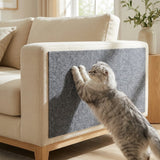
- Add one scratch surface beside a sofa or doorway if claw marks already live there
You do not need a perfect cat palace on Sunday night. You need fewer single points of failure.
Multi-cat households: the silent asterisk
Two or more cats means extra work, and the statement says so. Tension between cats is often subtle (blocking, staring, schedule shifting) before it becomes obvious fighting (per 2024 intercat tension guidance). Separated resources and multiple safe places are not luxuries in those homes. They are infrastructure.
FAQ
Is indoor-only always best?
Lifestyle tradeoffs exist, and feline vets discuss risks and benefits of different setups. Supervised outdoor time (enclosed "catios," harness walks) is one way some families add stimulation while limiting free-roam hazards. Choose with your veterinarian and local risks in mind.
Will following the pillars stop all behavior problems?
No checklist erases every issue. Pillars reduce preventable distress. Persistent house-soiling, aggression, or appetite changes still need professional evaluation.
Do I need to buy specialty products?
Not necessarily. Boxes, paper bags (handles removed), cardboard scratchers, and your own wand-toy skills cover a lot. Buy when a tool clearly fills a gap you already identified.
Where can I read more from the source?
Start with the 2025 indoor-cats statement and the caregiver environmental-needs PDF listed in Sources below, plus the older detailed environmental-needs guidelines.
Takeaway
Indoor life is a welfare project, not only a safety setting. The five pillars ask caregivers to build safe places, separated resources, real predatory play, predictable social contact, and scent-aware homes. Walk the five pillars once, fix the biggest gap first, and treat enrichment as daily maintenance for a curious species living in our square footage.
Sources
- FelineVMA. 2025 indoor cats position statement news release (Aug 28, 2025). https://catvets.com/news/2025-indoor-cats-position-statement/
- FelineVMA. Meeting the Physical and Emotional Needs of Indoor Cats (2025), Journal of Feline Medicine and Surgery. https://catvets.com/resource/2025-meeting-the-physical-and-emotional-needs-of-indoor-cats/
- FelineVMA. Environmental Needs caregiver PDF. https://catvets.com/wp-content/uploads/2025/02/FelineVMA-Environmental-Needs_Web.pdf
- Ellis SLH, et al. AAFP and ISFM Feline Environmental Needs Guidelines. Journal of Feline Medicine and Surgery, 2013. https://pmc.ncbi.nlm.nih.gov/articles/PMC11383066/
- Rodan I, et al. 2024 AAFP Intercat Tension Guidelines. Journal of Feline Medicine and Surgery, 2024. https://pmc.ncbi.nlm.nih.gov/articles/PMC11292941/
- Ellis SLH. Environmental enrichment. Journal of Feline Medicine and Surgery, 2009. https://journals.sagepub.com/doi/10.1016/j.jfms.2009.09.011