


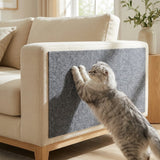


If your cat treats the arm of the couch like a gym membership, you are not failing as a cat parent. Scratching is normal feline behavior. What is newer is how researchers describe why cats pick the sofa in the first place.
The short version for home: your cat often picks the sofa because it sits near where they nap and where you come and go. So put a good scratch surface right there, beside the arm they love, instead of in a lonely corner. A 2025 survey of nearly 1,800 cat caregivers backs this up and challenges a common story that unwanted scratching is mostly stress marking.
Cats scratched most often near resting places, comfort zones, and social spaces (beds, couches, living rooms, doorways), not the classic "anxious boundary" spots many of us assume.
Below: what that means in plain English, a few nuances from a second study, and a practical redirect plan. It is educational, not a veterinary diagnosis. If scratching suddenly spikes with other behavior or health changes, talk with your veterinarian or a qualified behavior professional.
What you'll get
- What the 2025 survey actually measured (and what it did not prove)
- How a 2024 study adds nuance about play, night activity, and post placement
- A calm, research-aligned way to redirect claws without punishment
- Soft pointers to furniture protection only when redirect alone is not enough
Scratching is maintenance, stretch, and communication
Scratching does several jobs at once. Cats scratch to shed outer claw sheaths, stretch the body after rest, leave visual and scent marks, and express emotional state. So the goal is not to erase scratching. Teach where to scratch (per ASPCA scratching guidance).
That framing matters because punishment (yelling, chasing, forcing paws onto a post) can damage trust and, in some cases, make conflict worse. Do not force paws onto a post, and do not treat declawing as a behavioral fix.
What the 2025 survey found
Home takeaway: If your cat loves the sofa arm, ask first whether that spot is near a nap zone or a greeting path. Put an appealing scratch surface there, not across the house in a lonely corner.
What was asked: About 1,800 caregivers (largely UK and US) described where and when their cats scratched across home locations tied to feeding, resting, social life, and territorial edges.
Key pattern: Scratching clustered around rest, comfort, and social engagement more than around classic "stress boundary" narratives. Living-room and sofa-adjacent areas showed up strongly. Homes with dogs actually reported less scratching (dogs can be stressful for some cats, so this undercuts a simple "more stress equals more scratching" story).
Honest limits: This is survey-based, not a lab experiment that proves emotion in every cat. Some contexts may still track frustration (for example, scratching a closed bedroom door). Treat it as a useful rethink, not a claim that stress never matters.
What a 2024 study adds
A 2024 study of caregiver reports on 1,211 cats in France scored unwanted scratching by frequency and intensity. Associations linked with more unwanted scratching included:
- Presence of a child in the home (association, not proof of causation)
- Longer or more intense play patterns and higher nocturnal activity
- Caregiver-rated aggressiveness or disruptiveness
- Scratching-post placement and whether the cat actually used the provided surface
Posts placed in rooms where the unwanted scratching already happened tended to matter. Cats that did not use the provided post or tree were overrepresented in the higher-scratching group.
Practical read (conservative): Busy, playful, night-active cats may need better-timed play and better-placed surfaces, not "more random toys in a closet." Very long, overstimulating play right before you want quiet can leave a cat wound up. Short hunting-style sessions that end with a catch and a small food reward work better (a long-standing feline environmental-needs recommendation).
A research-aligned redirect plan (no punishment)
Use this as a household checklist, not a medical protocol.
- Map the favorite wrong spot. Note height (vertical vs horizontal), material (fabric weave, wood edge), and nearby rest or greeting traffic.
- Match the legal surface to that preference. Tall sturdy vertical posts for full-body stretch; horizontal cardboard or sisal for cats that prefer floor-level rakes. Offer variety until you learn the preference, then duplicate winners in key rooms.
- Place the good option beside the problem. Same wall, same traffic line. A post in another room is easy for humans to ignore and easy for cats to ignore too.
- Make the sofa temporarily less rewarding. Soft covers, double-sided tape designed for pets, or purpose-built scratch guards buy time while the new habit sticks. This is protection, not a personality change for your cat.
- Reward use of the right surface. Quiet praise, a brief play cue, or a small treat when you catch legal scratching. Never drag paws down a post.
- Keep play short and complete. Aim for a few minutes of stalk-chase-pounce that ends with the cat "winning" the toy, then a pause. If nights are wild, shift a play snack earlier in the evening.
When a soft product tie helps
Research will not glue your upholstery back together overnight. If you need a temporary barrier while redirect sticks, a sofa-facing protector or anti-scratch mat can cover the exact panel your cat prefers. Casa Michi carries options in Comfort & Scratchers, including an Anti-Scratch Sofa Mat and a Sofa Scratch Protector. Use them as training aids beside a good scratch post, not as the only plan.
FAQ
Does sofa scratching mean my cat is anxious?
Not automatically. The 2025 survey found scratching often clustered with rest and social areas. Stress can still play a role for some cats and some contexts. Look at the whole picture (resources, play, multi-cat tension, sudden changes) rather than labeling one claw mark as anxiety.
Will more scratching posts fix everything?
Only if they match preference and location. An unused post in the wrong room is furniture, not enrichment. Placement and actual use matter most.
Should I punish scratching?
No. Startle tactics can teach fear of you. Redirect and protect instead. Declawing is not a behavior solution endorsed by major welfare organizations.
Is this veterinary advice?
No. These are summaries of published behavior research and public welfare guidance for everyday home management. Persistent distress, aggression, or sudden behavior change deserves professional help.
Takeaway
Cats scratch because they are cats. Newer research suggests many sofa sessions sit closer to comfort and social life than to a simple stress-marking script. Pair that insight with solid redirect habits: preferred surfaces, same-room placement, short complete play, and temporary protection when you need to save the couch while the new habit forms.
For a step-by-step plan, see how to redirect sofa scratching without punishment.
Sources
- Braggs J, Mills DS. Unwanted feline scratching in the home: A re-examination of its relationship with stress and marking. Applied Animal Behaviour Science, 2025. DOI: 10.1016/j.applanim.2025.106635
- Salgirli Demirbaş Y, et al. Evaluating undesired scratching in domestic cats: a multifactorial approach to understand risk factors. Frontiers in Veterinary Science, 2024. DOI: 10.3389/fvets.2024.1403068
- ASPCA. Destructive Scratching. https://www.aspca.org/pet-care/cat-care/common-cat-behavior-issues/destructive-scratching
- Ellis SLH, et al. AAFP and ISFM Feline Environmental Needs Guidelines. Journal of Feline Medicine and Surgery, 2013. https://pmc.ncbi.nlm.nih.gov/articles/PMC11383066/